
The SPA Youth Advisory Committee Welcomes a New Cohort and Celebrates the Legacy of Its First Members
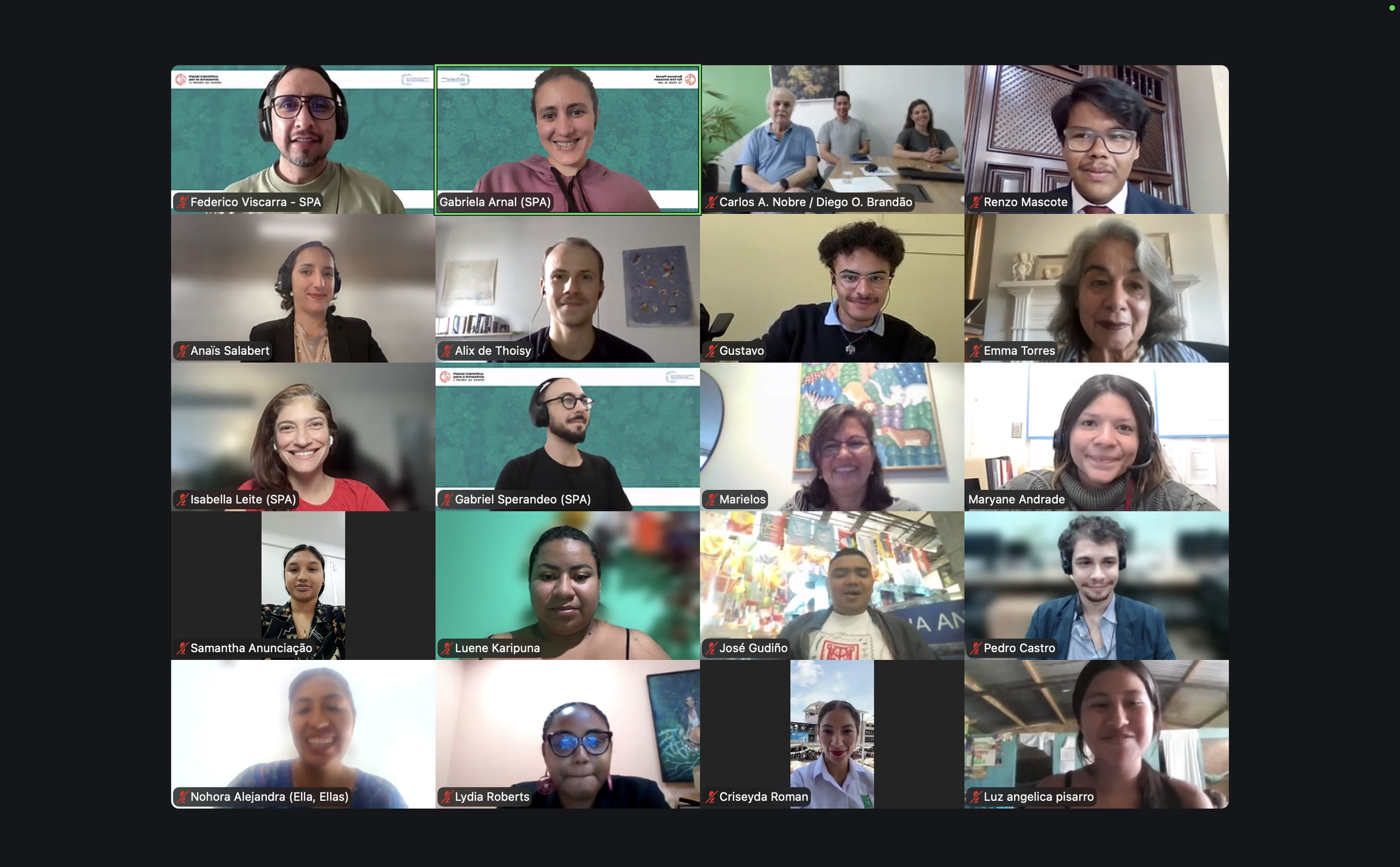
The Science Panel for the Amazon (SPA) Youth Advisory Committee (YAC) marked a new chapter in its work during a welcome and farewell meeting on October 13, 2026. The gathering brought together incoming and continuing YAC members, outgoing YAC members, and SPA leadership to reflect on the committee’s achievements since its launch in 2024, recognise the contributions of its first SPA’s youth committee and look ahead to the 2026–2028 incoming new team.
The meeting celebrated both the work accomplished over the past two years and the community built among young people committed to advancing knowledge, collaboration, and action for the Amazon.
Two Years of Youth Engagement and Collaboration
Launched at the United Nations Summit of the Future in September 2024, the YAC brought together 13 young people from seven Amazonian countries, selected from more than 500 applicants. Its purpose is to integrate youth perspectives into the SPA’s activities and outputs, broaden awareness of the Panel’s work among young people, and strengthen collaboration between the SPA and youth organizations.
In her welcome remarks, Emma Torres, SPA Strategic Coordinator, congratulated the YAC on its achievements over its first two years and their contributions to advancing the next generation of scientists for The Amazon We Want. She also highlighted an important further development step: drawing on the committee’s experience to support the establishment of Youth Advisory Committees for the Science Panel for the Congo Basin (SPCB) and the Science Panel for Borneo (SPB).
Reflecting on the committee’s first two years, outgoing member Anaïs Salabert highlighted achievements across three areas: knowledge sharing, science communication, and representation and networking.
Through the Science Across Generations webinar series, YAC members helped connect young people with scientific knowledge presented in the SPA’s Amazon Assessment Reports. They also contributed to webinars with SDSN Caribbean and SDSN Youth.
In science communication, the committee produced 12 episodes across two seasons of the podcast Conversations for The Amazon We Want, developed an initial influencer database and strategy, and created social media content to help bring the SPA’s work to wider audiences.
The committee also organized five national and regional workshops, bringing together more than 200 participants and contributing to the development of the Amazon Youth Manifesto, launched at COP30. Other initiatives included databases of job opportunities and young leaders and early-career scientists, as well as mentorship circles covering topics such as climate change, Indigenous rights and local knowledge, and geography and biodiversity.
YAC members also participated in international events and discussions, including COP30, the United Nations General Assembly, Climate Week NYC, and other scientific and youth-focused gatherings. Beyond these activities, Anaïs emphasized a legacy that extends beyond individual projects: the community built through two years of shared work, friendship, mutual support, and connections across countries and backgrounds.
Recognizing the Contributions of the Outgoing Members
The meeting also recognised five members concluding their active participation in the YAC: Anaïs Salabert, Felipe Storch, João Pedro Braga, Meset Fernando Mashingashi Unkuch, and Maryane Andrade.
SPA Co-Chair Marielos Peña-Claros thanked the outgoing members for their contributions and reflected on their individual involvement in the committee’s work. Continuing YAC member Pedro Neves de Castro also shared a heartfelt message of appreciation, while outgoing members offered reflections and advice for those beginning their terms.
Their contributions have helped establish a foundation for the committee’s future work. As they move into the YAC Alumni network, their experience and connections can continue to support the broader community of young people engaged in the SPA’s mission.
Welcoming the 2026–2028 Cohort
The meeting welcomed eight new members to the YAC: Alix de Thoisy, Lydia Roberts, José Gudiño, Luz Angélica Pisarro Gasca, Bruno Rafael Marques, Luene Karipuna, Renzo Mascote de Andrade, and Samantha Anunciação.
Each introduced themselves and shared their backgrounds, interests, and expectations for their participation. Their experiences span different fields and contexts across the Amazon region, including conservation, research, Indigenous rights and knowledge, and the visibility of communities whose perspectives are essential to understanding the region.
Their introductions reflected the value of bringing together diverse experiences and perspectives. For example, new member Luz Angélica Pisarro Gasca emphasized that young people living in the Amazon are not only part of its future but are already contributing to knowledge and biodiversity conservation through their everyday practices and relationships with their territories. Lydia Roberts highlighted the importance of Indigenous knowledge and conservation, as well as the opportunity to advocate for Indigenous peoples and learn from other young people across the region.
SPA Co-Chair Carlos Nobre welcomed the new members, underscoring the importance of youth engagement in addressing the challenges facing the Amazon. He highlighted the role that young scientists and leaders can play in informing decision-making and contributing to conservation and more sustainable development in the tropics. He also encouraged continued collaboration among youth advisory committees as similar initiatives develop in other tropical forest regions.
SPA Senior Program Manager Isabella Leite welcomed the new members, recognizing the selection process and the responsibility that comes with contributing to the committee’s work. The incoming cohort will build on the foundations established by the first group while bringing new perspectives, ideas, and initiatives to the YAC.
Looking Ahead: The YAC 2026–2028
The meeting outlined some priorities for the committee’s consideration over the next two years. The work continues across its three strategic areas: knowledge sharing, science communication, and representation and networking.
Planned activities may include the webinar series on the SPA’s Amazon Assessment Report 2025, launching the youth-led technical paper developed with the Amazon Sustainable Landscapes Program (ASL) at COP31, and exploring further podcast episodes, social media initiatives, and an initial influencer campaign.
The committee is also considering continuing a new cycle of mentorship circles in January 2027 and conduct a youth consultation survey and workshop to contribute to the SPA’s research agenda. The incoming and continuing members will work together to develop the YAC’s 2027–2028 work plan and identify new initiatives.
These priorities build on the committee’s experience while creating opportunities for new members to shape its direction and strengthen youth connections to scientific knowledge and decision-making.
A Continuing Community
The transition from the first YAC cohort to the 2026–2028 group is both a moment of recognition and an opportunity to renew the committee’s commitment to its mission. The outgoing members have a strong legacy of projects, partnerships, and a community that will continue through the Alumni network, while the incoming members bring fresh perspectives and initiatives to engage youth in building The Amazon We Want.
By sustaining collaboration across cohorts and strengthening youth participation in the SPA’s activities, the YAC will continue to contribute to the Panel’s efforts to synthesise and communicate scientific knowledge, interwoven with Indigenous and Local Knowledge, to support sustainable and equitable development in the Amazon.
The welcome and farewell meeting marked the closing of one chapter and the beginning of another—one grounded in the achievements of the first and shaped by the next generation of young people working toward a resilient future.
