
Science Panel for the Amazon joins First Conference on Transitioning Away from Fossil Fuels and Contributes to Key COP30 Presidency Roadmaps
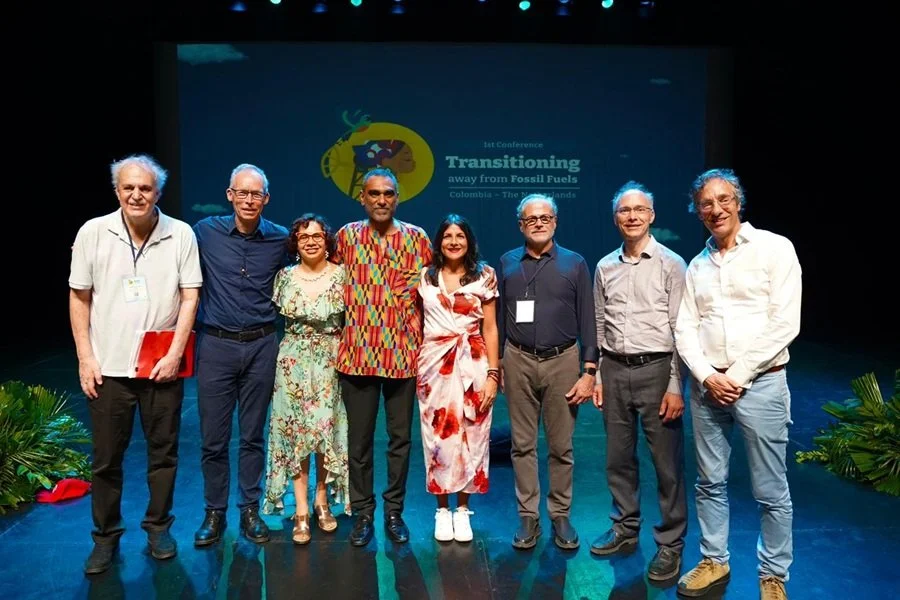
Photo credit: Colombian Ministry of Environment and Sustainable Development
On April 24-29, 2026, the First Conference on the Transition Away from Fossil Fuels convened in Santa Marta, Colombia: a landmark gathering aimed at advancing a global framework to move beyond fossil fuels. The Science Panel for the Amazon (SPA) Co-Chair, Dr. Carlos Nobre, joined the opening plenary and a featured session organized by We Don't Have Time, contributing the SPA's perspective on the Amazon's role in the energy transition.
The conference also marked a significant moment for the broader scientific community: on the sidelines, the Colombian government announced the creation of the Science Panel for the Global Energy Transition (SPGET), the first global scientific body dedicated exclusively to guiding the phase-out of fossil fuels. Dr. Nobre was among the scientists present at the launch, alongside figures such as Johan Rockström, Director of the Potsdam Institute for Climate Impact Research.
The SPA's Written Contributions to the COP30 Presidency Roadmaps
Ahead of the conference, the SPA formally submitted contributions to two of the COP30 Presidency's action-oriented roadmaps.
The first, submitted to the Roadmap for Transitioning Away from Fossil Fuels in a Just, Orderly and Equitable Manner, situates the Amazon at the heart of the global energy debate. The SPA's contribution underscores that global warming, combined with deforestation and forest degradation, is pushing the Amazon closer to a tipping point — a threshold that, if crossed, would accelerate global warming, reduce moisture flows across South America, and compromise the biological and cultural assets essential for humanity's future. The submission identifies critical barriers to the transition, including Amazonian governments' structural dependence on fossil fuel revenues, the lack of sustainable energy infrastructure in remote communities, and weak intersectoral coordination between energy, environment, and Indigenous and local governance systems. It also outlines concrete enabling pathways: decentralized renewable energy solutions adapted to Amazonian environments, the establishment of "green royalties" to offset foregone oil revenues, to stop new oil and gas extraction in the Amazon, and the promotion of socio-bioeconomies as viable alternatives.
The second contribution, to the Roadmap to Halting and Reversing Deforestation and Forest Degradation by 2030, provides science-based evidence across the full spectrum of deforestation drivers, from land tenure insecurity and illegal economies to governance gaps and infrastructure expansion. It also maps pathways to reverse them with key recommendations that include strengthening cross-border governance through the Amazon Cooperation Treaty Organization (ACTO), mandating supply chain traceability, titling of at least 50 million hectares for Indigenous and local territories by 2030, and scaling up restoration.
Both submissions reflect the SPA's ongoing commitment to translating science into actionable policy, ensuring that the Amazon's socioecological realities are present in the decisions being made at the highest levels of global climate governance.
A second Conference on the Transition Away from Fossil Fuels was announced, to be co-hosted by Ireland and Tuvalu in early 2027. Three thematic workstreams were established to carry the process forward, and the conference report will be handed over to the COP30 Presidency to inform its roadmap, shared ahead of the intersessional meetings of the UNFCCC in Bonn and formally presented at London Climate Action Week, both in June 2026.
The SPA will continue to contribute to these processes and to engage in key international spaces, bringing science-based recommendations where decisions about the planet's future are made.
Find our contributions and other publications here:
https://www.sp-amazon.org/publications/#other-publications
