
The SPA at PARLAMAZ: Bringing the Best Available Science to Amazon Policymakers
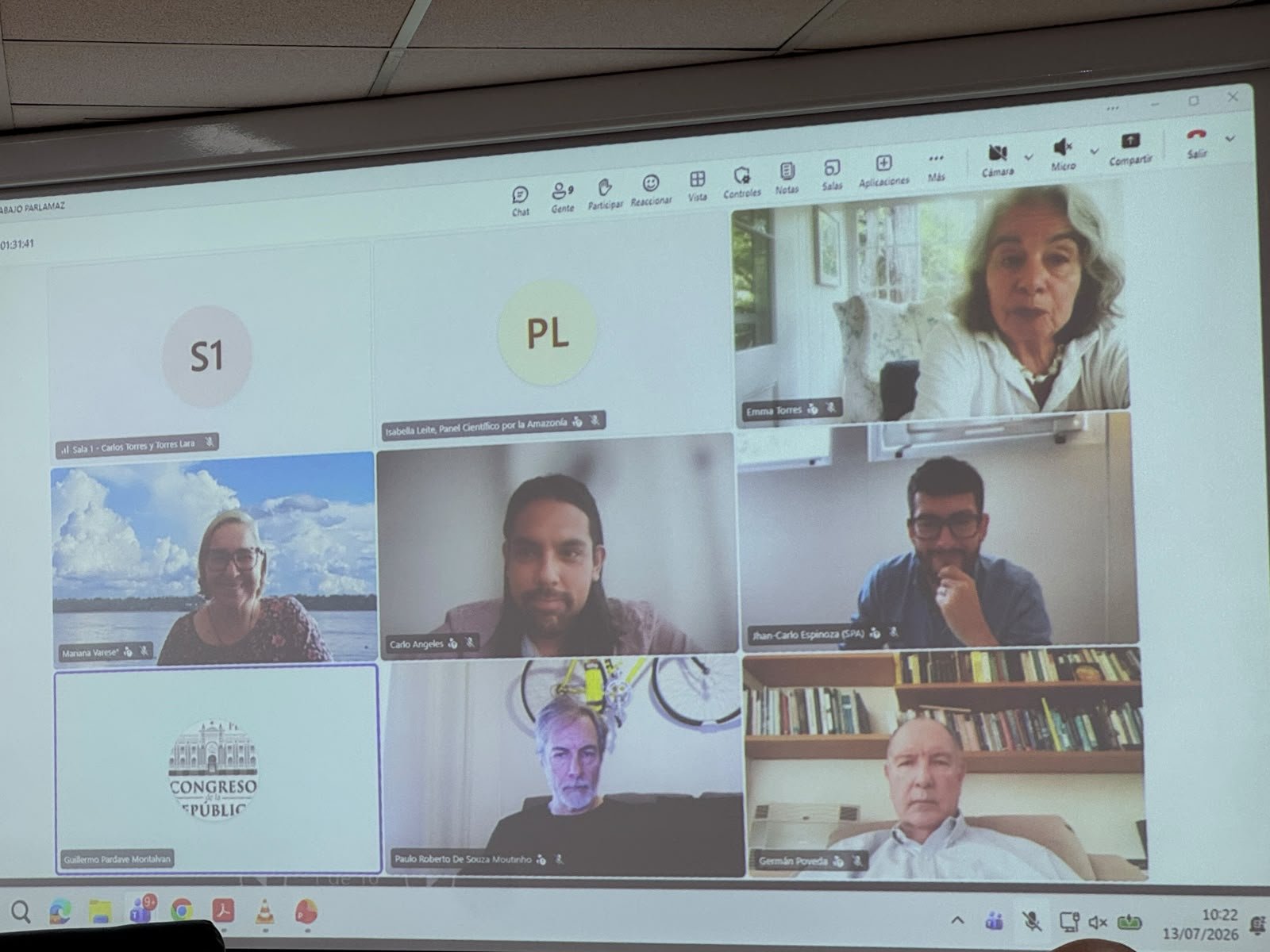
On July 13, 2026, the Science Panel for the Amazon (SPA) participated in a strategic working session of the Amazon Parliament (PARLAMAZ) — the permanent parliamentary cooperation and integration body that brings together national congresses from Amazon Basin countries — held at the Congress of Peru in Lima. The session marked the closing of the current working cycle of the Peruvian Delegation to PARLAMAZ, while also serving as a transition meeting with the incoming Senate and Chamber of Deputies.
The SPA was represented virtually by members of its Science Steering Committee: Jhan-Carlo Espinoza and Mariana Varese, who delivered the main presentation, with Germán Poveda and Paulo Moutinho serving as discussants. From the SPA Secretariat, Strategic Coordinator Emma Torres, Senior Program Manager Isabella Leite Lucas, and Senior Fellow Carlo Angeles were also present.
Bringing Amazon Science to the Legislative Table
The session was opened by Congresswoman Karol Paredes Fonseca, Vice President of PARLAMAZ representing Peru, who welcomed participants and presented the General Report of PARLAMAZ's current working cycle. Her remarks set the tone for a session that placed science and regional cooperation at the center of the legislative agenda.
The SPA's participation centered on the presentation of key findings from the 2025 Amazon Assessment Report: Connectivity of the Amazon for a Living Planet (AR2025). The framing was direct from the outset: PARLAMAZ, and Peru in particular (as the only country to have formally institutionalized it within its governance), represents one of the most strategic spaces for translating science into legislative action.
Jhan-Carlo Espinoza and Mariana Varese presented the scientific evidence on Amazon connectivity and its disruptions, highlighting that the Amazon is not only a forest but a deeply interconnected system linking ecosystems, water cycles, peoples, and economies across the continent. Among the key messages shared:
The Amazon regulates South America's water cycle through "flying rivers" generated by forest evapotranspiration, with approximately 50% of the rainfall reaching the Peruvian and Bolivian Andes originating from Amazonian forests.
Extreme droughts and floods have increased significantly in both frequency and intensity: in Manaus (Brazil) for example, what was once one extreme flood every 20 years has become one every four years since 2000.
Between 10% and 47% of Amazonian forests could face combined disturbances by 2050 that risk triggering irreversible ecosystem transitions.
Environmental degradation directly increases health risks: for every square kilometer deforested, 27 new malaria cases are registered.
The presentation addressed the direct link between environmental degradation and public health. Drawing on AR2025 Chapter 3: Conserving Ecosystems and Their Connectivity for Health Promotion in the Amazon, the SPA made the case for a One Health approach as an integrated framework to address these challenges in a coordinated manner. Specific recommendations included: recognizing forest management, conservation, and restoration as components of preventive healthcare; promoting multisectoral cooperation across levels of government and international cooperation; monitoring and responding to environmental changes; integrating public health, biodiversity, and deforestation indicators across Amazon countries; conducting national and cross-border risk assessments; and strengthening both primary healthcare networks and intercultural community health systems.
The SPA's presentation closed with the five key recommendations of the 2025 Amazon Assessment Report, calling on legislators to:
Conserve and restore the ecological and sociocultural connectivity of the Amazon.
Support Indigenous Peoples and Local Communities in safeguarding that connectivity and mitigating climate change.
Promote conditions that enable socio-bioeconomies.
Foster cross-border collaboration to manage shared resources and curb illegal economies.
Create large-scale financial mechanisms to support forest and river conservation and restoration.
Science, Health, and the Amazon: A Shared Agenda
César Vladimir Munayco Escate, Director General of the National Center for Epidemiology, Disease Prevention and Control, of Peru's Ministry of Health, presented the country's current malaria situation and its transition from a control strategy toward an elimination strategy, noting that more than 90% of Peru's malaria cases are concentrated in Loreto. The SPA's intervention reinforced this call for action, framing forest degradation not only as an environmental challenge but as a public health crisis requiring cross-sectoral solutions.
The session also brought in additional voices from the incoming legislature. Senator-elect Víctor Noriega stressed that sustainable development in the Amazon must balance economic development, environmental protection, and social inclusion. Congressman-elect Francisco Gatica reaffirmed his commitment to continuing PARLAMAZ's work and strengthening collaboration with academia, the health sector, and neighboring Amazon countries.
The session closed with the formal reading and presentation of the Declaration on the Fight Against Malaria in Peru and the Amazon, presented by Congresswoman Karol Paredes.
Science and Policy: Building Stronger Bridges
The meeting demonstrated broad consensus among policymakers, scientists, public health experts, and partners that the Amazon's environmental and health challenges are deeply interconnected and require integrated, cross-border solutions. The incoming legislature reaffirmed its commitment to science-based policymaking and stronger collaboration between government, academia, and international partners. Participants also expressed a shared commitment to deepen institutional collaboration between PARLAMAZ and the Science Panel for the Amazon to ensure that scientific evidence systematically informs policymaking.
For the SPA, this kind of engagement is central to the Panel's mission. Spaces like PARLAMAZ offer a direct channel to bring the best available science to the decision-makers who shape policy for the Amazon. The region is at a critical juncture, but also at a moment of historic opportunity.
The findings presented during the session are also consistent with an emerging policy and systemic risk framework advanced by SPA Senior Fellow Carlo Angeles: understanding the Amazon as regional critical infrastructure. From this perspective, maintaining Amazon connectivity is not only an environmental objective, but a systemic condition for protecting water security, public health, food and energy systems, macroeconomic and fiscal stability, and regional resilience across South America.
Maintaining Amazon connectivity is therefore an essential condition for regional resilience and for avoiding the point of no return, getting there demands a stronger science-policy interface, coordinated cross-border governance, and financial mechanisms commensurate with the Amazon’s systemic regional and global role.
