
The Science Across Generations Dialogue Series Is Back — and Discussing Connectivity
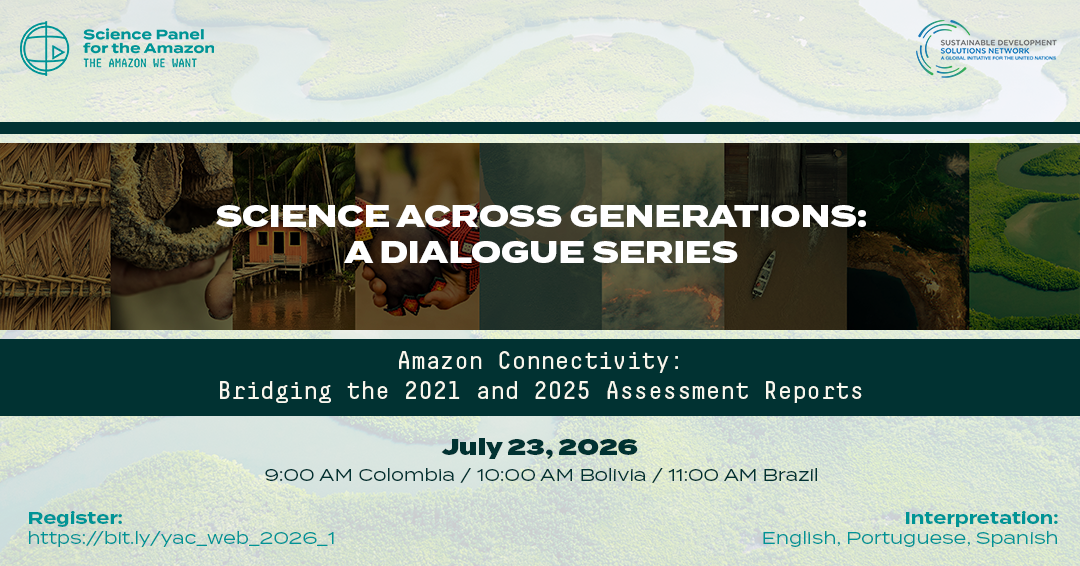
Following a successful cycle of "Science Across Generations: A Dialogue Series" in 2025, with three webinars on key chapters of the 2021 Amazon Assessment Report (AR2021), the Youth Advisory Committee (YAC) of the Science Panel for the Amazon (SPA) is back with a new cycle of the series for 2026.
The first session of the year took place online on July 23, 2026, and served as a key transition conversation between the 2021 Report and the new 2025 Amazon Assessment Report (AR2025). The event, titled "Amazon Connectivity: Bridging the 2021 and 2025 Assessment Reports," brought together SPA Lead Authors and young YAC members in an enriching conversation that shed light on the evolution of the SPA's work and the concept of Amazonian connectivity as a central framework.
The webinar opened with a presentation by Andrea Encalada, SPA Former Co-Chair and Lead Author of both the 2021 and 2025 Assessment Reports, who walked participants through the Panel's work and achievements since its official launch in 2020. Andrea also highlighted key themes explored in the AR2021 that laid the groundwork for the deeper focus on connectivity in the AR2025. She emphasized the importance of the connection between forest and water, referencing the SPA Policy Brief "Conserving the Amazon's Freshwater Ecosystems' Health and Connectivity," of which she is a Lead Co-Author, launched in 2024.
Next, Marielos Peña-Claros, SPA Co-Chair and Author of both the 2021 and 2025 Assessment Reports, spoke about the collaborative experience behind the construction of the AR2025. She delved into the concept of Amazonian Connectivity, noting that: "The ecological and sociocultural connectivity of the Amazon is defined as the interconnection within and between ecological and social systems, describing the flow and movement of resources, information, and people within and across geopolitical borders." She presented the eight dimensions of connectivity explored across the report's eight chapters, and offered a look at the 31 Calls to Action — current solutions and innovative interventions being developed and implemented by diverse actors at multiple scales that can be adapted and replicated. Marielos closed her intervention by emphasizing that safeguarding ecological and sociocultural connectivity is a strategy for mitigating climate change and conserving the integrity of the Amazon, a message being advanced together with the North Amazonian Alliance (ANA), the Amazon Network of Georeferenced Socio-Environmental Information (RAISG), and the Amazonian Waters Alliance, as a Coalition for Amazonian Connectivity.
José Gregorio Díaz Mirabal, Lead Author of the 2025 Report, Member of the SPA Strategic Committee, and Coordinator of Climate Change and Biodiversity at the Coordinator of Indigenous Organizations of the Amazon Basin (COICA), then took the floor. Gregorio brought the concept of connectivity to the foreground from a territorial perspective, sharing the SPA's work through an Indigenous worldview. He highlighted key ideas from AR2025 Chapter 5, of which he is Lead Co-Author, titled "Connectivities and Territorialities from the Perspectives of Indigenous Peoples, Afrodescendant Peoples, and Local Communities in the Amazon."
In line with the report's content, Gregorio emphasized how Amazonian peoples understand their territory as a series of inseparable interconnections — where animals, plants, rivers, forests, sky, subsoil, and spirits are all intimately and irrefutably connected. He then walked participants through the chapter's Calls to Action, highlighting among them "Establish Spiritual Connectivity to Conserve the Amazon," and underscoring the importance of giving relevance and credibility to spirituality as a key component of Amazonian integrity, conservation, and resilience.
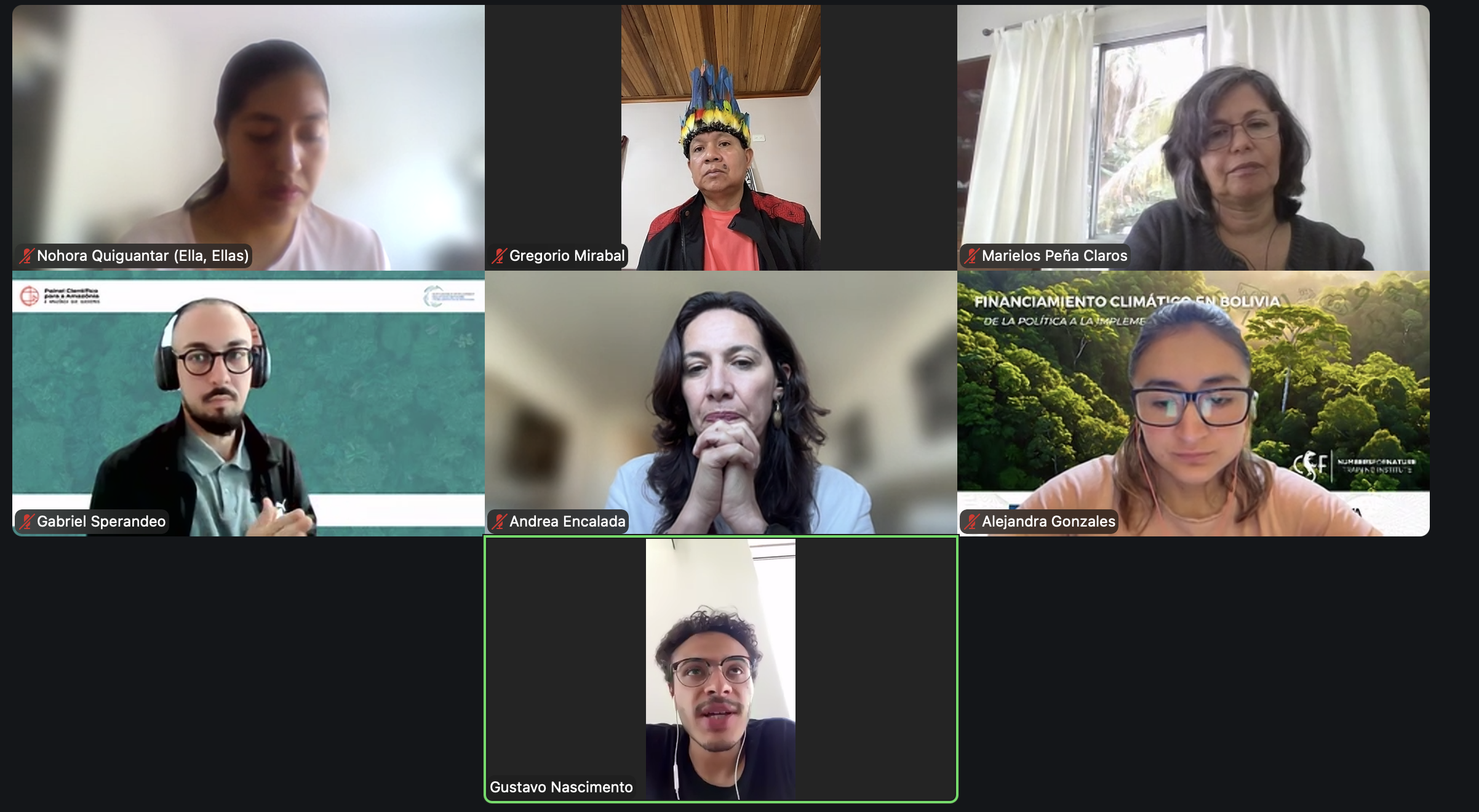
Following these important interventions by Panel experts, a dialogue opened with YAC members Gustavo Nascimento (Brazil), Nohora Quiguantar (Colombia), and Alejandra González (Bolivia), who shared their reflections on the SPA's journey between the AR2021 and AR2025, and on Amazonian connectivity as a central axis in the region's current narrative.
Gustavo opened the round of reflections by highlighting the importance of the Panel's ongoing research and periodic work, noting that it represents a highly relevant scientific contribution for the region. He also drew attention to the interweaving of Indigenous and Local Knowledge throughout the report, as well as the participation of young people across the Panel's various efforts — both as expressions of genuine commitment to including the diversity of Amazonian voices.
Nohora, as an Indigenous woman, offered an important reflection on the fundamental role of Indigenous knowledge for the sustainable development and future of the Amazon. She also posed a highly pertinent question to the experts: "How do we train a new generation of Indigenous scientists who do not have to choose between Academia and their Cosmovision?"
In response, Gregorio Mirabal shared several key examples, including the experience of the "Escuela Viva de la Amazonía" promoted by the Amazon Sacred Headwaters Alliance — an itinerant training process aimed at strengthening Indigenous knowledge. These kinds of initiatives are scalable and replicable, and require support from universities to help build that new generation of Indigenous scientists. Andrea Encalada also joined the conversation, particularly from her perspective as former Provost of the Universidad San Francisco de Quito (USFQ), calling for recognition of the complementarity between Western science and Indigenous science and ancestral knowledge. Both Gregorio and Andrea, along with members of the audience, added reflections on the growing challenge posed by Artificial Intelligence — as another model that could threaten ancestral wisdom and intellectual property.
Alejandra also intervened, reflecting on Amazonian connectivity from a long-term perspective and its future importance. She used renewable energy as an example, noting that when the different dimensions of connectivity are taken into account, the logic can shift. She recalled the example of dam construction raised by Andrea in her presentation, and the implications it can have when it fragments not only ecological but also social connectivities. Marielos Peña-Claros responded to this reflection by affirming that it is indeed essential to understand the Amazon as an interconnected system, where the decisions of one country have direct implications for others. She also noted that advancing the connectivity agenda as a conservation mechanism will require a key role from the Amazon Cooperation Treaty Organization (ACTO), which has the capacity to genuinely drive cross-border action.
The conversation between SPA experts and YAC members continued to deepen through audience questions and closing reflections that touched on several powerful themes:
The importance of interdisciplinarity and intergenerationality as pillars of the Panel's work;
the role of knowledge dialogues, without which it will not be possible to advance toward a truly resilient Amazon;
the multiplicity of knowledge systems as key to safeguarding Amazonian connectivity;
and the importance of political action from Amazonian youth.
In the words of Gregorio Mirabal: "To save the Amazon, we need Indigenous science, Western science, but also the action of everyone." The Amazon We Want is one where connectivity is not only understood but actively protected — where forests, rivers, peoples, and knowledge systems remain interwoven, and where that interconnection is recognized as the essential condition for the Amazon's resilience and the well-being of the planet. Safeguarding ecological and sociocultural connectivity is not just a scientific recommendation: it is a call to action for governments, communities, scientists, and youth alike.
The series will continue with a next session dedicated to Chapter 1 of the AR2025, on September 16, 2026.
📺 Watch the webinar:
English: https://youtu.be/xTzeBQTQvyw
Spanish: https://youtu.be/_Ns3SmljxAo
Portuguese: https://youtu.be/flZ6kWb6HXs
📄 Access the 2025 Amazon Assessment Report: https://www.sp-amazon.org/ar2025
