
Science Across Generations explores Amazon global and regional connectivity and pathways to halt deforestation and degradation
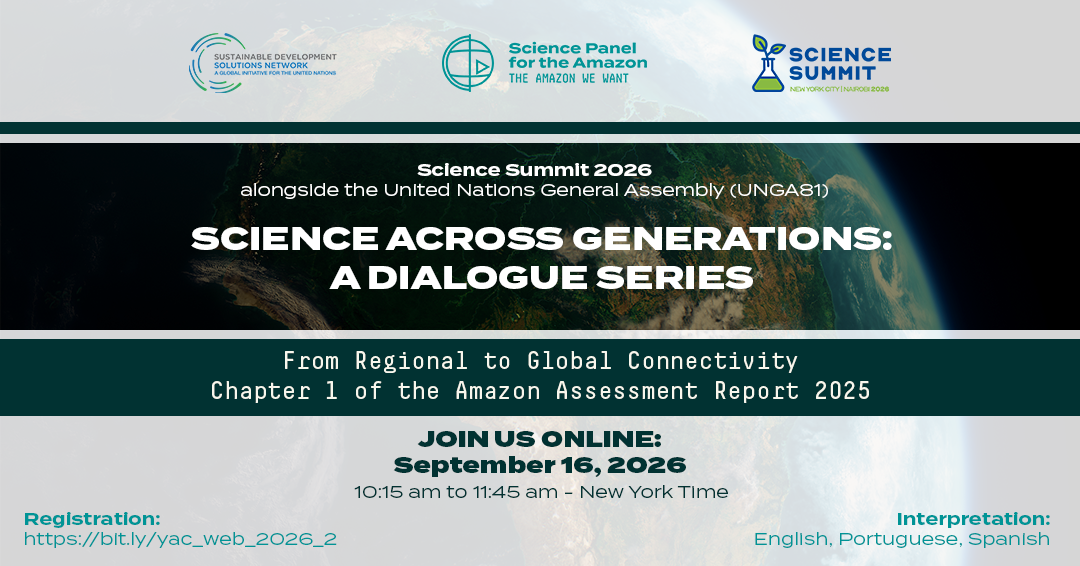
On September 16, 2026, the Science Panel for the Amazon (SPA) and its Youth Advisory Committee (YAC) convened the second webinar of Science Across Generations: A Dialogue Series. Held as part of the 2026 Science Summit alongside the 81st session of the United Nations General Assembly (UNGA 81) and Climate Week NYC, the session brought scientific, Indigenous, and youth perspectives into dialogue on the connections between the Amazon and the wider world.
The webinar, From Regional to Global Connectivity, focused on Chapter 1: of the Amazon Assessment Report 2025 (AR2025), titled “Amazon connections from regional to global Impacts and vulnerabilities” and its Call to Action 1: “Halt Amazon Deforestation and Degradation”. The discussion explored how these connections sustain ecosystems and communities, and what their protection requires in practice.
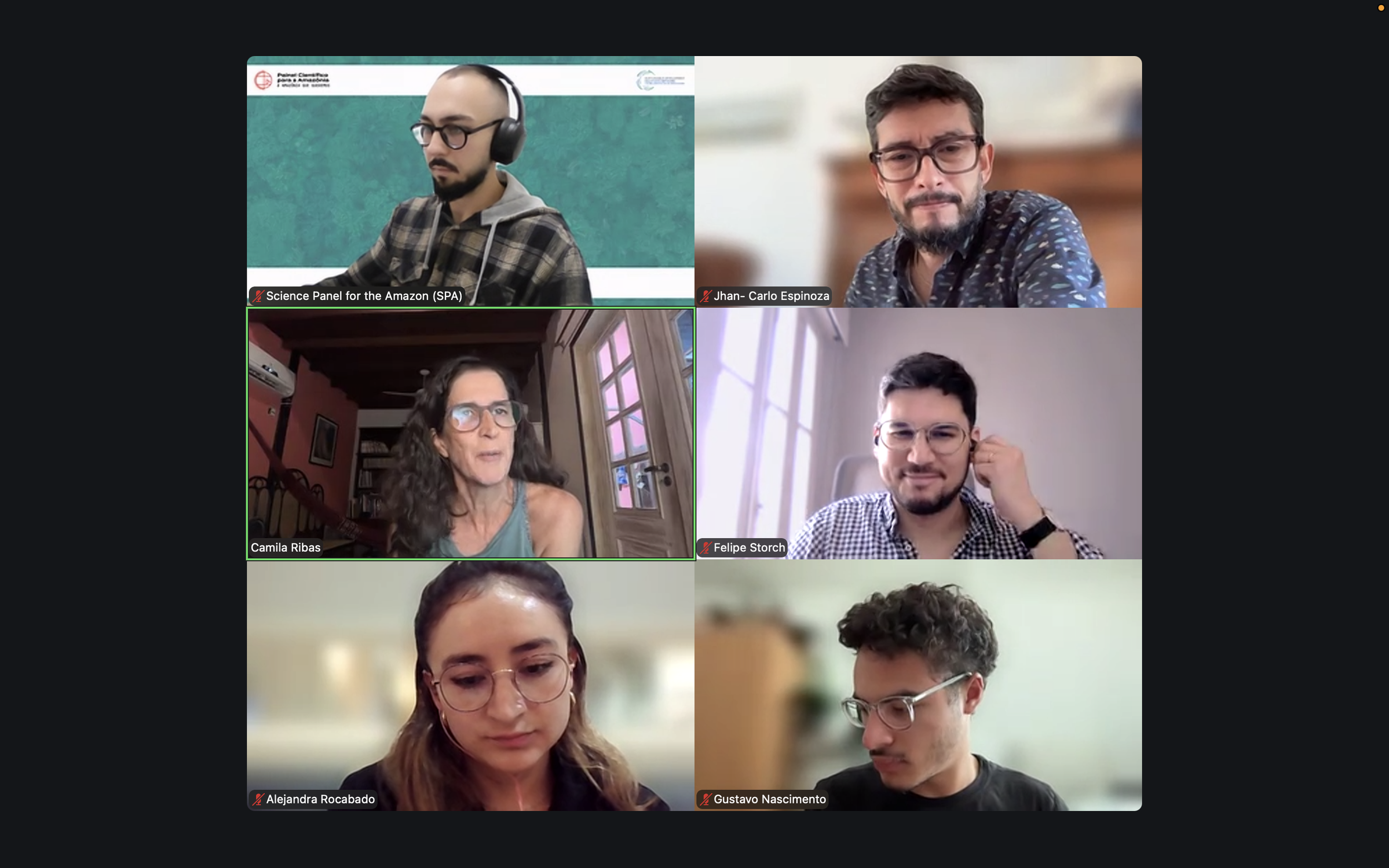
The session featured Jhan-Carlo Espinoza, Research Director at the French National Research Institute for Sustainable Development (IRD) and Lead Author of Chapter 1, Sinéia do Vale Wapichana, Indigenous leader from the Indigenous Council of Roraima (CIR) and contributing author of the chapter, and Camila C. Ribas, researcher at the National Institute for Amazonian Research (INPA) and co-author of Call to Action 1.
YAC members Felipe Storch, Gustavo Nascimento, and Alejandra Gonzales Rocabado joined the dialogue, moderated by Gabriel Sperandéo of the SPA Secretariat.
Connecting planetary processes with life in the territories
Jhan-Carlo Espinoza opened the round of presentations by explaining the connections among the Andes, the Amazon, and the Atlantic Ocean. Rivers carry sediments and nutrients from the mountains through the basin, while forests return moisture to the atmosphere through evapotranspiration. These “flying rivers” help sustain rainfall beyond the forest, linking Amazon conservation to water availability across South America.
His presentation also examined changes in floods and droughts, illustrating how disruptions to Amazon connectivity affect both the climate system and the territories where people experience their consequences.
In her video contribution, Sinéia do Vale connected these processes to the well-being and subsistence of Indigenous Peoples. She explained how flying rivers and other connections discussed in Chapter 1 influence conditions in Indigenous Territories. She also described how El Niño is affecting communities, bringing the discussion of climatic processes into the context of everyday life.
Camila Ribas presented the Call to Action 1, emphasizing the need to address forest degradation alongside deforestation. She highlighted the importance of Indigenous Territories and Protected Areas in maintaining connectivity, while explaining that pressures originating beyond their boundaries can still undermine their ecological integrity.
The Volta Grande do Xingu provided a concrete example. Camila described independent environmental monitoring led by Indigenous and riverine researchers in collaboration with academic scientists, examining the impacts of altered river flows associated with the Belo Monte hydropower plant. This work demonstrated the contribution of local knowledge and community leadership to understanding environmental change.
An intergenerational dialogue on conservation and development
YAC members Felipe Storch, Gustavo Nascimento, and Alejandra Gonzales Rocabado joined the SPA authors in an exchange on conservation finance, climate preparedness, and communication. Their participation brought youth perspectives into the discussion of how the chapter’s findings can inform decisions about the Amazon’s future. The dialogue explored the need for long-term support to keep forests standing and for greater recognition of the benefits they provide beyond the Amazon. It also addressed the importance of investing in prevention rather than relying on responses to environmental emergencies.
Camila emphasized that Indigenous Peoples’ relationships with their territories reflect cultural values and ways of living that cannot be assessed through financial returns alone. Supporting conservation also means respecting these priorities and ensuring access to public services that allow communities to remain in their territories with dignity.
The exchange addressed preparedness for climate extremes, including support for community responses to fire risks. Participants also discussed concerns about greenwashing and the need to ensure that climate finance contributes to conservation in practice.
Another theme that was discussed was how to communicate scientific findings beyond academic settings. The speakers highlighted the contribution of science communicators and the importance of maintaining Indigenous and Local leadership when sharing research conducted in their territories.
Audience questions on evidence and development
Audience questions extended the discussion to the influence of Indigenous-led monitoring on decision-making. One question highlighted the systematic and professional quality of the work presented by Camila and asked whether project developers and relevant authorities recognized and used the reports and data collected by Indigenous Peoples.
The ensuing exchange addressed the challenges of translating evidence into action by those responsible for projects and their impacts. It highlighted the importance of recognizing Indigenous research and supporting its use in decisions affecting communities.
Another question asked whether dialogue could help build a shared understanding of development with the communities involved, and whether there were examples of experiences that had helped reconcile differing perspectives. The discussion examined tensions between prevailing economic models and community priorities, emphasizing democratic participation and the involvement of affected peoples in shaping decisions.
Chapter 1 in a word or expression
To close the session, Gabriel invited each panelist to describe Chapter 1 in a word or expression. Camila chose “paradigm shift”, Jhan-Carlo “balance”, Alejandra “connectivity”, Felipe “strategy”, and Gustavo “a necessary challenge.”
These reflections brought the session back to the relationship between understanding Amazon connectivity and deciding how to maintain and restore it, with contributions from different generations and knowledge systems.
The series will continue in November 2026 with a webinar focused on Chapter 2 of the Amazon Assessment Report 2025.
Watch the full series of dialogues here.
Explore the 2025 Amazon Assessment Report.
