
Young Voices for Amazon Connectivity
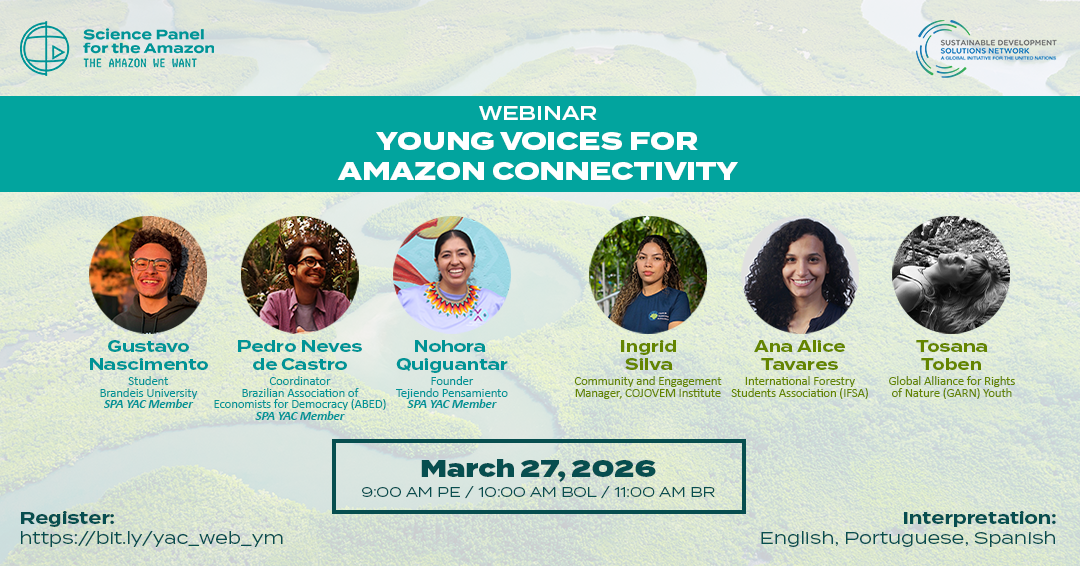
What happens when young people come together to discuss connectivity, science, and the future of the region? More than just a debate, important reflections emerge on socio-bioeconomy, knowledge production, and the role of the new generation in building pathways toward a sustainable and resilient Amazon.
These were some of the central themes of the webinar “Young Voices for Amazon Connectivity,” held on March 27, 2026, organized by the Youth Advisory Committee (YAC) of the Science Panel for the Amazon (SPA). The event brought together members of the YAC and representatives of youth-led or youth-focused international organizations to present the YAC’s Amazon Youth Manifesto, and to discuss ways to strengthen youth participation in the scientific and environmental agendas of the region.
Presentation of the Amazon Youth Manifesto
The first part of the webinar was dedicated to presenting the Amazon Youth Manifesto: Voices for Connectivity and Climate Action, officially launched at COP30 in November 2025, and developed through a participatory process led by YAC members.
Pedro Neves de Castro, YAC member, economist, and PhD candidate in Socio-Environmental Development (NAEA/UFPA), opened the presentation by outlining the origins of the manifesto and the collective process behind it. He highlighted that the initiative emerged from the mobilization of Amazonian youth seeking to strengthen spaces for dialogue and regional collaboration. The process brought together the perspectives of more than 200 young people from across all Amazonian countries through five workshops, culminating in the consolidation of their contributions into a shared document.
Next, Gustavo Nascimento, YAC member and Environmental Studies and Anthropology student at Brandeis University, presented the manifesto’s key findings. He emphasized the understanding of the Amazon as a living and interdependent system, where ecological, sociocultural, and economic dimensions are deeply interconnected. This perspective aligns with the Amazon Assessment Report 2025 - Connectivity of the Amazon for a Living Planet, and is reflected in the Youth Manifesto. He also highlighted key challenges identified by youth, including deforestation, territorial conflicts, the dominance of extractivist economic models, and the exclusion of young people from decision-making processes.
Closing this segment, Nohora Quiguantar, YAC member and Indigenous Colombian biologist, presented the manifesto’s recommendations for key stakeholders, including political leaders, Indigenous Peoples and Local Communities, the private sector, academia, and civil society. Among the main proposals are strengthening integrated public policies, ensuring territorial rights, and expanding access to climate finance. She also emphasized the importance of promoting ethical and collaborative science, reinforcing territorial governance, and increasing youth participation in decision-making processes.
Youth in Action: Initiatives Strengthening Networks and Opportunities
The second part of the webinar featured presentations from representatives of youth-focused and international cooperation initiatives, who also shared their inputs to the manifesto.
Tosana Toben, from the Global Alliance for the Rights of Nature, highlighted the importance of the Youth Manifesto for education and presented the Floresta Escola project as an initiative to strengthen educational opportunities for Amazonian youth. She also shared the network’s work in supporting young researchers and leaders engaged in defending the Rights of Nature. Toben is a researcher in feminist political ecology and an advocate for the Rights of Nature; within GARN, she co-leads the Youth Hub and serves on its Executive Committee.
Next, Ana Alice Tavares, from the International Forestry Students Association, reinforced the ecological dimension highlighted in the Youth Manifesto and discussed how it can be implemented through training and capacity-building opportunities for young people in ecology and forestry, emphasizing the role of academic exchange and international cooperation. Tavares is a PhD candidate in Environmental Diplomacy with a Master’s in Tropical Forestry, and her research focuses on development cooperation with traditional communities in the Amazon.
Closing the session, Ingrid Silva, from COJOVEM – Amazon Youth Cooperation for Sustainable Development, highlighted how the Youth Manifesto resonates with Amazonian youth. She emphasized culture as a key dimension in the discussion and presented initiatives focused on strengthening youth leadership and promoting civic engagement across the region. Silva is an agronomist from Pará and serves as Community and Engagement Manager at COJOVEM.
Discussions Toward the Future
The plenary discussion brought together the six speakers to reflect on how to translate the manifesto’s ideas into concrete action. Three key themes emerged from the exchange:
The first was socio-bioeconomy, considered one of the most promising pathways to reconcile environmental conservation and development in the Amazon. Participants emphasized the importance of strengthening biodiversity-based value chains, as well as expanding public policies and investments to support this sector.
Another central topic was the role of Indigenous Peoples and Local Communities in academia. The discussion highlighted the need to increase their presence in universities and research centers, while also promoting processes of knowledge co-production that recognize and value diverse knowledge systems.
The role of youth in scientific research was also discussed. Despite growing interest among Amazonian youth in scientific careers, significant barriers remain, particularly in relation to access to education, funding, and research networks.
What Comes Next?
The Amazon Youth Manifesto: Voices for Connectivity and Climate Action represents a meaningful step toward strengthening the participation of Amazonian youth in global debates on climate, biodiversity, and development. Grounded in a participatory process and a shared regional vision, it brings forward concrete perspectives on connectivity and the transformations needed across ecological, sociocultural, and economic dimensions.
The challenge ahead lies in translating these proposals into public policies, research agendas, and practical initiatives that effectively strengthen connectivity across the Amazon. This requires sustained collaboration between science, policy, and society, as well as the meaningful inclusion of youth in decision-making spaces.
In this context, the Youth Advisory Committee (YAC) of the Science Panel for the Amazon will continue to advance this agenda by fostering dialogue, amplifying youth voices, and creating opportunities for engagement. This includes initiatives such as the “Conversations for The Amazon We Want” podcast, participation in key events, and contributions to SPA outputs, ensuring that the perspectives and priorities of Amazonian youth remain an active part of regional and global conversations.
Watch the webinar:
English
Portuguese
Spanish
